Learn About Dominique Ingres in Art History, View His Art and Famous Paintings
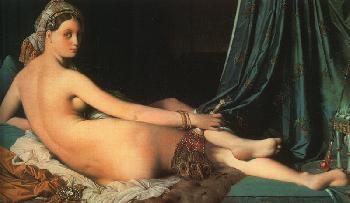
"Grande Odalisque” Dominique Ingres, 1814
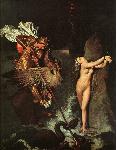
Dominique Ingres, 1780-1867,, another of France’s famous artists in art history painted "The Envoys of Agamemnon" in 1801. The painting was an academic exercise in classical art composition, favorable to those ruling in the fine arts academy. The academy standards for artwork was symmetrical balance, tightly controlled linear edges, reserved coloration, smoothly rendered paint, and a balanced simplified composition. Ingres managed to fit all these requirements into his artwork and won the Prix de Rome with this famous painting in 1801.
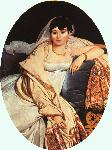
Dominique Ingres was also a portrait artist. In 1806 he painted one of his most famous paintings "Madame Riviere, an oval composition.
 Around this time elements not favorable to classicism began showing up in his artwork. Ingres painted
patterned draperies, Madame Riviere is wearing a light airy scarf, and in the lines of the folded fabric have an abstract quality. Ingres’ artwork is changing away from an austere simplistic compositional format acceptable to the academy in 1806.
Around this time elements not favorable to classicism began showing up in his artwork. Ingres painted
patterned draperies, Madame Riviere is wearing a light airy scarf, and in the lines of the folded fabric have an abstract quality. Ingres’ artwork is changing away from an austere simplistic compositional format acceptable to the academy in 1806.
The peculiarities of "Madame Riviere", the uneven length of her arms and the seeming disappearance of her lower body, go mostly unnoticed due to the beautifully rendered drapery folds. Ingres left for Rome shortly afterward, and would a second time due to the criticism he received for this painting.
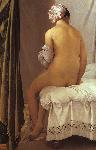
In the years Dominique Ingres spent in Rome, he painted "Bather of Valpincon", 1808, a painting that returned to the classical art, simpler, more austere composition, in its smoothly painted tightly controlled linear edges. The smooth modeling of the woman's body adds a new characteristic to Ingres' paintings, a sensual, sexual quality.
In 1814, Ingres painted "odalisque"(a Turkish word for harem slave girl), a continuation of the decorative art style of painting he was criticized for in "Madame Riviere", mainly being "Gothic". "Odalisque" is dramatically rich in color and textures, from the furry animal skin, to the peacock feathers,to the wrinkled sheets she is laying on, and then the smoothly rendered figure of the woman’s body. The subject matter and accessories in this painting is exotic, a characteristic of the Romantic movement in art history.
The date of Ingres' portrait painting of "Francois Granet" is unknown.Ingres made an improvement in the validity of the figure occupying space and in the articulation of details compared with "Madame Riviere".
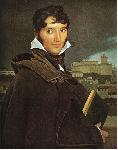 The portrait has the same sensual linear qualities, as “Madame Riviere” with added sensual sensitivity in his brushwork seen in Granet's coat.
The linear lines in one of Dominique Ingres’s famous paintings "Comtesse de Tournon", 1814, are much harsher with stronger highlights in the velvety dress than are the soft fluid folds of Granet's coat. "Granet’s" highlighting is softer in this artwork more characteristic of the fabric he is wearing.
Ingres seems to have caught more of Comtesse's personality in her portrait that is missing in his other portraits.
Another characteristic of Ingre's portraits is his formulaic triangle composition of his sitters, possibly influence by Italian High Renaissance Art in his self inflicted exile of fourteen years to Italy.
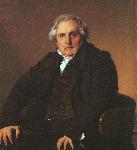
Ingres painted another of his famous paintings in art history, a portrait of "Monsieur Bertin", in 1832, capturing even more personality of the sitter rather than just a representation of his likeness.
Dominique Ingres always saw himself as a classicist and couldn't understand the criticism he received being Romantic and Gothic in his linear quality. For the second time in his life, in 1834 Ingres left Paris for Rome where he refused all commissions and forbid the showing of his artwork in the Salon. He later returned again to Paris in 1841 aged 61. Other famous artists of the Romantic art period are Eugene Delacroix and Antoine Gros.
To view the entire gallery of Dominique Ingres paintings, click here.
Click on the graphics below to increase graphic sizes. At the same you time can also view an opportunity to purchase a poster or painting reproduction.