Learn About Paul Cezanne in Art History, View His Art and Famous Paintings
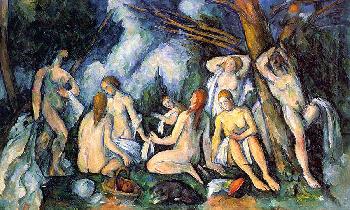
"The Large Bathers”, Paul Cezanne, 1900-05
Paul Cezanne, 1839-1906, one of France’s famous artists in art history, painted during the time of the great Impressionists. He exhibited art in two of their group shows including the Impressionists' controversial opening exhibit.
He stated "I want to make of impressionism something solid and durable like the art of the museums", moving himself out of the impressionist period and into Post Impressionism.
His direction was to combine two different and opposite art styles, Nicholas Poussin's order and a style of immediacy. It meant imposing order on nature without destroying the character derived from it's inconsistencies and non-conformities.
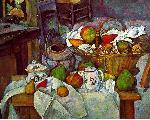
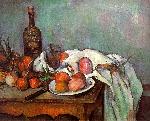
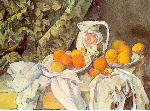
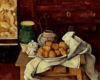
Paul Cezanne differed with the Impressionists representation of light and atmospheric effect, choosing universal light without shadow. In one of Cezanne's famous paintings in art history, "The White Sugar Bowl", 1890-94, Cezanne eliminates atmospheric effect. Time of day is non-existent.
 His art objects are simplified to elemental planes of varying color compared to the impressionist non-linear broken brush strokes of color.
An example of Paul Cezanne's simplified planes of color are the apples and pears in “The White Sugar Bowl”. Inside the linear boundaries of these objects or planes, color was applied in overlaid, varying, shifting planes of colored strokes lending itself to an expressive emotion. There is no descriptive detail in the apples and pears. They are ultimately brought into compositional balance and relationship through varying thicknesses of boundary lines and the simplified articulation of the tablecloth.
The objects themselves, are the planes to be adjusted according to the artists desire and purpose. The table is not a true perspective of how a table looks. The darker tone on the backside of the table that normally shows recession backward into space has been used in this artwork, to bring the edge of the table to the forefront, through intense saturation of the dark color. At the whim and choice of the artist, Paul Cezanne chose to be totally inconsistent with three-dimensional perspective, choosing to balance using different methods.
The vertical linear brushstrokes disrupting the back linear edge of the table is inconsistent with three-dimensional perspective too.
The strokes are not consistent with the reality of a table edge, but are added to balance the composition and eliminate the long unbroken harsh edge of the the table, standing alone.
The license to distort and abstract objects at the artist’s discretion, lead artists away from Impressionism and into the beginnings of modern twentieth century abstract art.
The simplification of form to its basic element by Paul Cezanne, is consistent with French thought of nobility. Simplicity reflects truth, and respect for that truth. In another of his famous paintings "The Card Players", 1890-92, there is a dignity presented in the simple way of life.
 Elements of the painting have been reduced to four figures, a table, a chair, pipes hanging on the wall and a curtain. There is no attention paid to detail or exact representation of any of these objects.
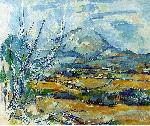
Paul Cezanne further eliminates linear three-dimensional perspective in the landscape painting "Mont Sainte-Victoire", 1882-85.
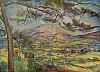 Instead he uses color value to recede into space which diminishes recession into space on its own account. Atmospheric conditions are gone, replaced by solidified form and universal light.
In a later landscape, "Mont Sainte-Victoire from Les Lauves", 1904, Cezanne’s art style becomes more abstract in the use of color planes and brush strokes.
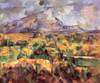 There is no attempt to articulate houses and buildings. Building representation is laid down using rectangular planes of color abstraction. Balancing the artistic composition the rectanglar strokes are repeated in the sky
.
One of Paul Cézanne’s last famous paintings in art history "The Great Bathers", 1898-1905,
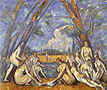 was important to the development of abstract painting of the twentieth century. Paul Cezanne took a normal landscape and changed its composition using planned arrangements, planned movements and planned distortions. This method became characteristic of later
abstract art painters. Other famous artists of the Post Impressionism are van Gogh and Paul Gauguin.
was important to the development of abstract painting of the twentieth century. Paul Cezanne took a normal landscape and changed its composition using planned arrangements, planned movements and planned distortions. This method became characteristic of later
abstract art painters. Other famous artists of the Post Impressionism are van Gogh and Paul Gauguin.
To view the entire gallery of Paul Cezanne paintings, click here.
Click on the graphics below to increase graphic sizes. At the same you time can also view an opportunity to purchase a poster or painting reproduction.